What is NIS2?
NIS2 is the EU cybersecurity directive (Directive (EU) 2022/2555) that sets the obligations for companies in essential and important sectors: managing their security risks, reporting serious incidents within fixed deadlines and holding senior management accountable. It replaces the first NIS directive from 2016. EU countries had to transpose it into national law by October 2024, but companies are only bound by their own country’s law, and several countries, Spain among them, have not passed theirs yet.
For the IT department, NIS2 comes down to something very concrete: knowing which assets you have, who can access what, how you respond to an incident, and being able to prove it.
What changes from NIS to NIS2
The first NIS directive (2016/1148) fell short: each country decided which companies were in scope, and the rules varied widely from one to another. NIS2 tightens and harmonizes almost everything:
| NIS (2016) | NIS2 (2022) | |
|---|---|---|
| Sectors | 7, plus digital service providers | 18: 11 highly critical and 7 other critical |
| Who is in scope | Operators designated by each country | By sector and size: medium and large companies, plus some regardless of size |
| Categories | Operators of essential services | Essential and important entities |
| Incident reporting | Without undue delay | 24 h, 72 h and one month |
| Management | No specific obligations | Approves, oversees, is trained and is liable |
| Suppliers | Barely mentioned | Supply chain is part of risk management |
| Fines | Set by each country | Common: the cap cannot be lower than 10 million or 2% of turnover |
Who does NIS2 apply to?
NIS2 greatly expands the scope of the first NIS directive. It is no longer limited to large operators of critical infrastructure: it covers “essential” and “important” entities in sectors such as energy, transport, health, water, digital infrastructure, ICT service management, public administration, food, chemicals and manufacturing.
As a general rule, companies in those sectors are in scope from medium size upwards: 50 employees or more, or annual turnover and a balance sheet total that each exceed 10 million euros. Some entities are in scope regardless of size, such as DNS providers, trust service providers and public electronic communications providers.
Even if you are not obliged, many customers already require these measures in their contracts: if you work for an essential entity, you are part of its supply chain.
NIS2 key dates
- 27 December 2022: the directive is published in the Official Journal of the EU.
- 16 January 2023: it enters into force.
- 17 October 2024: deadline for member states to transpose it into national law.
- 17 April 2025: deadline for each member state to establish its list of essential and important entities.
Many countries missed the October 2024 deadline, but that is no reason to wait: national laws build on the directive, and the measures it requires cannot be put in place in a few weeks. Each national law sets the competent authority, the procedures and the penalties, so check with your legal advisers where your country’s law stands and whether your organization is in scope.
Risk management: the minimum you need
The directive asks for technical and organizational measures proportionate to the risk, not a fixed list of products. In practice, the IT department should be able to show that it has the following in place:
- Risk analysis and information security policies, approved and up to date.
- A clear incident handling procedure, with named owners.
- Business continuity: tested backups, a disaster recovery plan and crisis management.
- Supply chain security, including service providers.
- Security when buying, developing and maintaining systems, including vulnerability handling and patching.
- A way to assess whether the measures work: reviews, audits and indicators.
- Training and basic cyber hygiene practices for all staff.
- Encryption where it makes sense.
- Access control, asset management and HR security (joiners, movers and leavers).
- Multi-factor authentication and secure communications.
Almost every item starts with the same question: what do you have and who can access what? Without a reliable inventory of devices, licenses, cloud services and accounts, it is impossible to assess risk or prove that an offboarding was done properly.
Incident reporting deadlines
One of the most visible changes is the reporting timeline. When a significant incident occurs (one that causes, or could cause, severe disruption to the service or significant losses), the directive requires reporting to the competent authority or the relevant CSIRT at three points:
-
24 h
Early warning
A first notice that something has happened.
-
72 h
Incident notification
An initial assessment of severity and impact.
-
1 month
Final report
One month after the notification: description, root cause, mitigation measures and cross-border impact.
For the early warning and the notification, the clock starts when the organization becomes aware of the incident, not when it finishes investigating it; for the final report, it starts at the 72-hour notification. That is why early detection matters as much as knowing who decides whether an incident is significant.
Management is accountable too
NIS2 makes it clear that cybersecurity is not just an IT matter. Management bodies must approve the risk management measures, oversee their implementation and receive training. If they fail to do so, they can be held personally liable.
“Compliance is not a one-off project: it is the way IT is run every day.”
For the technical team it is an opportunity: at last there is a formal reason to ask for visibility, budget and time for the things that were always left for “when we have a moment”.
Fines: why you should not leave it for later
The directive sets minimums that each country can raise. For essential entities, fines of up to 10 million euros or 2% of worldwide annual turnover, whichever is higher. For important entities, up to 7 million euros or 1.4%. On top of fines, authorities can order audits, require affected customers to be informed and, in the most serious cases, temporarily suspend the people responsible.
Beyond the amount, the real cost of being late is usually something else: building in weeks what should have been built over months, while the business waits.
NIS2 and ISO 27001: what you already have
If your organization is certified to ISO 27001, or to a national scheme such as Spain’s National Security Framework (ENS), you are already a good part of the way there. They all start from the same place: risk analysis, proportionate security measures, incident handling and continuous review.
What NIS2 adds, or asks for in more detail:
- Fixed deadlines for reporting significant incidents to the authority.
- Personal accountability for management, with mandatory training.
- Supplier security as part of risk management.
- Registration of the entity with the competent authority.
No certification guarantees compliance on its own, but it is a good starting point: check which controls already cover each requirement and focus on the gaps.
How Monkinet helps you comply with NIS2
Most NIS2 requirements start with knowing what you have and who can access what. That is where Monkinet makes the difference: it brings everything an audit will ask for into a single dashboard, instead of spreading it across spreadsheets and separate tools.
- Asset and risk management. The device inventory, licenses and cloud services in one place: the basis for analyzing risk.
- Access control. Onboarding and offboarding set up and remove devices, accounts and licenses in one go, so nobody keeps access after they leave.
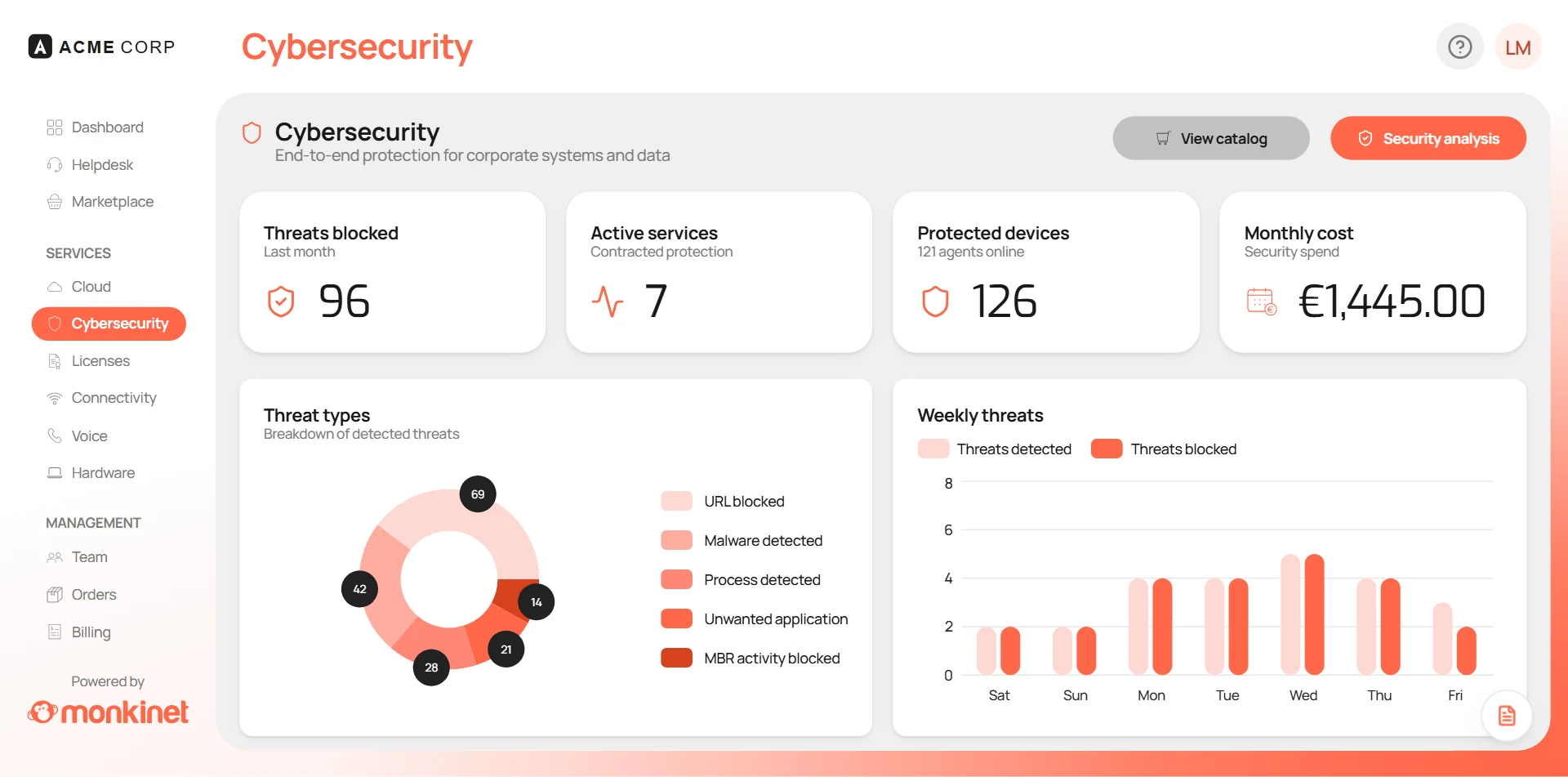
- Incident management. The Cybersecurity module brings together threat detection, incident response and device protection, with context from the rest of the platform.
- Business continuity. Backups in plain sight, alongside the rest of your cloud services.
- Supply chain. Supplier contracts, their amounts and renewal dates, ready to review.
NIS2 compliance does not come from a tool, but without a reliable picture of your IT environment you cannot comply. Monkinet gives you that picture in a single dashboard.
Conclusion
NIS2 raises the bar, but it does not require reinventing the IT department. Start with the inventory and access, document the incident procedure and review your suppliers. Once that is in place, the rest is keeping it up to date, and with Monkinet it all lives in one dashboard.
To put it into practice, our NIS2 compliance checklist goes item by item through what the IT department should be able to show in an audit.
- NIS2
- Compliance
- ISO 27001
- Incident management
- Cybersecurity
Written by the Monkinet Team
We write about IT operations, security and efficiency for teams that manage a lot with few resources.